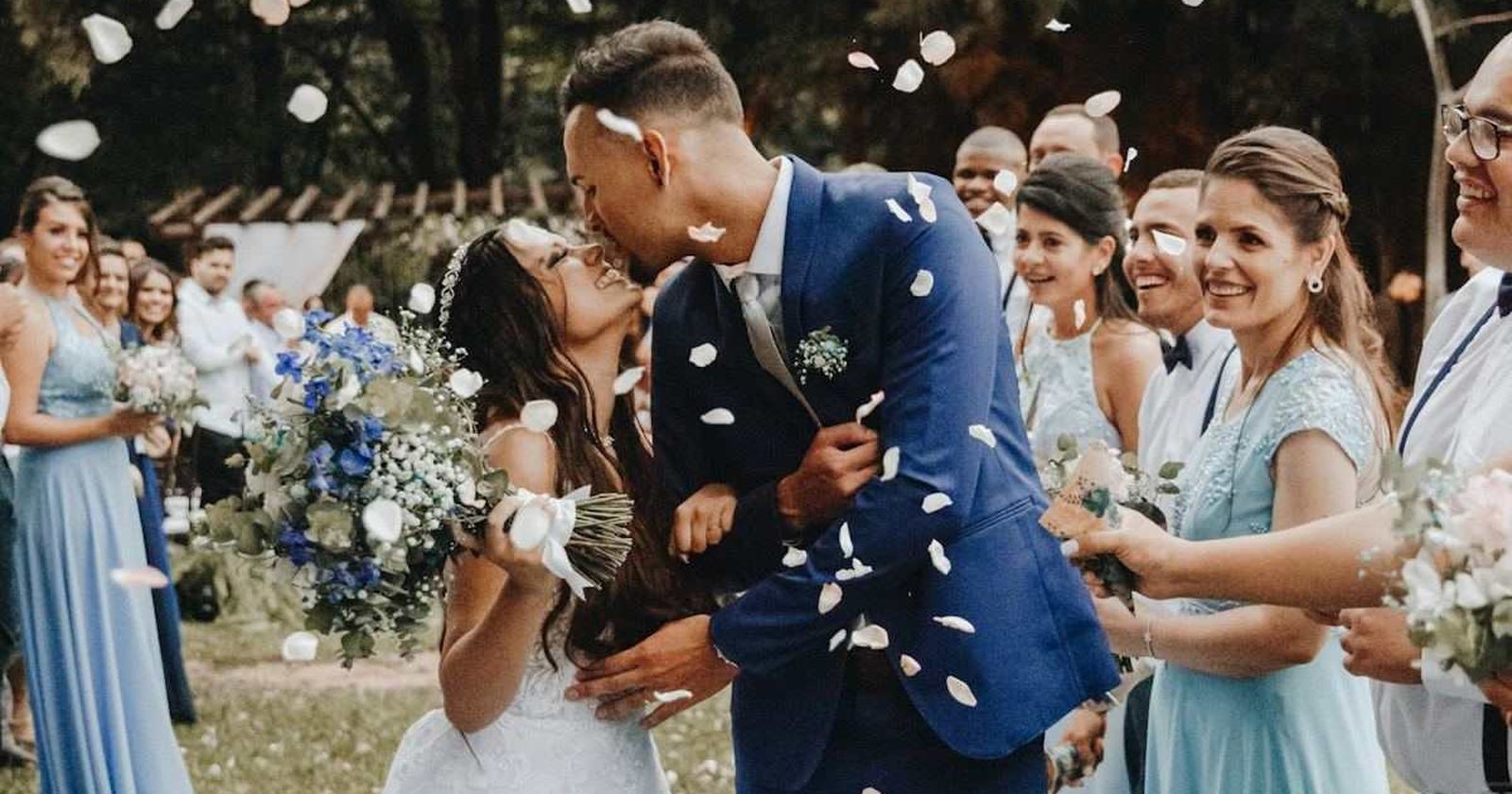
Wedding families are almost never monolingual anymore. You met at a conference in Amsterdam. Your parents live in different countries. One of you grew up switching between two languages at the dinner table and doesn't remember which one is the "main" one. Half your invitation list opens WhatsApp in Hebrew and the other half opens it in French. The template wedding site builders (The Knot, Zola, Joy, and the rest) offer you English. Maybe Spanish. That's the ceiling.
A wedding site built for your actual family looks different. It greets each guest in their own language, respects the direction their eyes want to read, and treats a grandmother in one country as a guest of honor rather than an afterthought.
Why multilingual matters for a mixed family
It's the difference between a grandparent feeling welcomed and feeling politely excluded from her own family's wedding. That gap is smaller than it looks and it matters more than it looks. A wedding website that speaks only English to a French-speaking grandmother tells her, without meaning to, that this event is really for the English speakers and she's a guest of theirs.
Imagine the guest list. Grandma in Casablanca reads French, always has. Your cousin in Tel Aviv reads Hebrew comfortably and English with a bit of effort. Your best friend in Brooklyn reads English. Your fiancée's uncle in Buenos Aires reads Spanish. The couple, of course, moves between all of them at every family dinner.
The English-only wedding site turns half of those people into second-class guests. They squint, they translate, they ask their kids what a word means, they show up to the ceremony still slightly unsure whether the reception is dinner or drinks. A well-built multilingual site turns that around: it lets every one of them open the same link, tap once, and read the whole thing in their own language. The RSVP form is in their language too. The dress code, the map to the venue, the story of how you met. The venue name stays as it is because that's how their taxi driver will hear it.
This is the invisible work of a really good wedding website. Nobody notices it. Everyone benefits from it. Grandma opens the link, sees her language, and knows she's at home in this celebration.
How language switching actually works on the site
A one-tap language picker sits in the top corner, always visible, always small enough not to shout. Your guest taps it once. The whole site changes: headings, body copy, menus, buttons, form labels, footer. The choice persists as they move from the story page to the RSVP to the map. They don't have to pick again on every screen.
Under the hood we build the site with real language versions. Every language has its own URL, its own translated content, its own metadata. That means the French version can be shared with a French relative and they'll open it in French; the Hebrew version can be sent to Israeli cousins and they'll open it in Hebrew. Search engines (when the couple chooses to be indexed at all) understand which version to show to whom.
Right-to-left languages get real right-to-left layout. Not text pasted into a left-to-right template. When a guest picks Hebrew or Arabic, the navigation flips to the right side, headings align right, and the whole page reads the way the language actually reads. Each language uses fonts chosen to render its script beautifully: a Fraunces-style display for Latin scripts, a matching Hebrew serif for Hebrew, a warm Arabic naskh for Arabic. Numbers and Latin words stay in their natural direction inside a right-to-left paragraph, which is how bidirectional text is supposed to behave.
None of this is a Google Translate widget bolted on top of an English site. That widget produces stiff, sometimes wrong, sometimes hilarious text. This is a wedding, not a stress test for a machine translator.
What to translate, and what to leave
Translate the parts guests need to act on; leave the parts that carry meaning in their original language. The list below is the working principle we use with every couple.
Translate: the story of how you met (guests love this section and grandma should love it in her language); the ceremony schedule and details; the RSVP form, top to bottom, including meal choices and the dietary questions; the dress code, with one warm sentence per event; the maps and directions to each venue; the hotel block and travel tips for out-of-town guests; the contact information for questions.
Leave in the original language: the names of venues, because that's how a taxi driver will hear the address; Hebrew or Arabic ceremony terms like chuppah, ketubah, henna, or nikah, ideally with a one-line gloss the first time they appear; a poem or a Bible verse or a Rumi line the couple loves in its original tongue; the meaningful Hebrew or Arabic phrase engraved on the invitation; family names spelled the way that family spells them.
These aren't rigid rules. They're editorial decisions, and they matter. A ketubah is not a "marriage contract" the way a car lease is a contract, and translating it flat loses the whole flavor of the moment. Meanwhile, "please let us know if you're bringing a plus one by June 15" absolutely needs to be in every language your guests read, no ambiguity, no charm points. When we build a custom multilingual wedding website with a couple, we make these calls line by line, together.
Right-to-left languages: doing them right
Hebrew and Arabic read right-to-left, and doing this properly is craftsmanship, not a checkbox. The layout should mirror: the navigation menu belongs on the right side of the screen, the logo often on the left; body text reads right-to-left, headings align right; the arrows on carousels point the other way; a "back" button sits where a right-to-left reader expects it to sit.
Punctuation and numbers stay left-to-right where they naturally do. A phone number in a Hebrew paragraph is still written the way phone numbers are written. A wedding date in Arabic still reads left-to-right if the numerals are Western. Bidirectional text has real rules and browsers know them, but only if the site was built to speak the language, not to fake it.
Typography deserves care. Hebrew has its own serif traditions, its own weight balances; a Hebrew paragraph set in a font designed for Latin script looks unloved. We pair each language with a display face and a body face that were drawn for that script by people who read it.
A guest reading in Hebrew should see a Hebrew website. Not an English website with some Hebrew text dropped in. That's the whole point.
The languages we work with regularly
Because mixed families come in every combination, we've built wedding sites in a lot of them. The list, roughly in order of how often we're asked:
- English. The default for many couples we work with; almost every site includes it.
- Hebrew. Full right-to-left, with the correct fonts and calendar handling for Hebrew dates alongside Gregorian ones.
- French. Extremely common for families with roots in France, Belgium, Morocco, Tunisia, or Quebec.
- Arabic. Full right-to-left, with careful typography and terms handled with respect.
- Spanish. Latin American and European varieties both; we ask which one the family prefers.
- Portuguese. Brazilian and European, same care about which variety.
- Italian. Often paired with English for weddings held in Italy.
- Farsi (Persian). Right-to-left, with the right script and idiom.
- Russian. Cyrillic done properly, including for older relatives who prefer it.
- Yiddish. Rare but real, and always for a reason that matters to the family.
This isn't an exhaustive list. If your family reads it, we'll build it. Dutch, German, Amharic, Turkish, Greek, Ladino: we've either done them or would happily do them for a couple whose family needs one.
How translation actually happens
The couple provides one language version, usually the one they wrote the site in first, and a native speaker writes the second. That's the whole process, and every part of it is deliberate.
The couple writes their own copy first, in whichever language feels most natural. That version is where the voice lives: the jokes, the family in-jokes, the way you introduced the ceremony to each other before you ever showed it to anyone else. It's a document, not a form to fill out.
Then a native speaker of the second language rewrites it. Often that's a family member. A bilingual aunt who's a natural writer, a sibling who's been living in Paris for a decade, a cousin whose Hebrew is stronger than the couple's. When there isn't a family volunteer we work with translators who specialize in weddings and celebration copy, not corporate documents. The result reads like it was written by someone who loves you, not by a stranger and not by a machine.
Machine translation has a place in the world. It's fine for a menu at a restaurant abroad. It is not fine for the paragraph where you tell your grandmother's community how she raised you. That paragraph is the whole reason the site exists.
We handle the technical side: the layout, the language switcher, the typography, the URLs, the SEO metadata for each version. You handle the voice. And your grandmother, opening the link in her language, feels the way you hoped she'd feel.
Your family reads three languages. Your website should too.
Tell us about your wedding and your guest list. We'll reply within 24 hours with a plan, a design direction, and a timeline.
Questions couples ask
Can a wedding website be in multiple languages?+
Yes, and it's one of the best reasons to have a custom site rather than a template one. A well-built multilingual wedding website has a language picker in the corner, real translations (not machine ones), right-to-left support for Hebrew and Arabic if needed, and typography that respects each script. Every visitor picks their language in one tap.
Do we need to translate the whole wedding website?+
The essentials, yes: the story, ceremony details, RSVP, dress code, maps, hotels. The extras are optional: a poem the couple loves might live in one language on purpose; ceremony terms like chuppah or ketubah can stay in Hebrew with a one-line gloss. Translation is an editorial decision as much as a technical one.
What languages do you build wedding websites in?+
Regularly: English, Hebrew, French, Arabic, Spanish, Portuguese, Italian, Farsi, Russian, and Yiddish. We can add others when a family needs one. What matters is that a native speaker (often a family member) writes the second-language version, so it reads like it was written by someone who loves you, not by Google Translate.
How does right-to-left support work for Hebrew and Arabic?+
The whole layout flips: navigation moves to the right, text reads right-to-left, headings align right. Numbers and English words stay left-to-right where they naturally do. This is real bidirectional support with the correct fonts, not a hack on top of a left-to-right template. Guests reading in Hebrew see a Hebrew website, not an English one with Hebrew text pasted in.

We design private, custom wedding websites for couples with families spread across languages, countries, and traditions. Multilingual sites are our quiet specialty. Updated July 2026.